Lights Out, Freak Out: The Luminescent Takeover That's Making the Dark Absolutely Magical
Lights Out, Freak Out: The Luminescent Takeover That's Making the Dark Absolutely Magical
Here's a question nobody asked but everybody needs to answer: when did turning off the lights become the most exciting creative decision a person could make?
Because somewhere between a teenager painting their entire ceiling with UV-reactive constellations and a nail artist in Portland charging $80 for a set that looks completely invisible until you walk into a blacklight bathroom, something clicked. The dark stopped being empty. The dark started being everything.
Welcome to the glow era. Population: basically everyone under 35 who owns a black light bulb and has strong opinions about phosphorescent paint brands.
The Bedroom Is the New Gallery (And It Hits Different at 2 AM)
Let's start where most great aesthetic movements begin — in somebody's bedroom at an unreasonable hour.
Blacklight murals have exploded across platforms like TikTok and Pinterest, with creators documenting entire room transformations that look, in regular lighting, like a perfectly normal wall. Maybe some abstract shapes. A few swirling lines. Nothing wild. Then the UV lamp flicks on and suddenly you're standing inside a fever dream painted by someone who clearly has a direct line to the cosmos.
Artists like @uvdreamer and a growing wave of DIY bedroom painters are using UV-reactive acrylics to build entire hidden worlds into their living spaces. Jungle scenes that only bloom after dark. Geometric portals that disappear in daylight. Constellations mapped to actual star charts. It's not just decoration — it's a secret. A version of your room that exists only for you and whoever you trust enough to turn the lights off with.
The appeal makes complete psychological sense. We are, as a generation, deeply exhausted by the performance of having a nice space. The visible, Instagram-optimized, always-camera-ready aesthetic has started to feel like a second job. But a glow mural? That's yours. That's private. That only comes alive when you choose to see it.
Rave Grandparents and the Cultural DNA of Glow
Neon and UV culture didn't materialize out of nowhere. It has roots — neon-soaked, sweat-drenched, absolutely legendary roots.
Rave culture from the late '80s and '90s built an entire visual language around blacklight. Fluorescent body paint, glowing bracelets, UV-reactive fabrics — the warehouse party aesthetic was practically built on the premise that darkness is a canvas. That ethos never fully disappeared; it just went underground for a while, waiting for a generation hungry enough for magic to drag it back into the light. Or, more accurately, out of it.
Gen Z and younger millennials are now consciously borrowing from that lineage. There's a reverence for rave aesthetics that feels less like nostalgia and more like recognition — oh, those people were onto something. The current glow obsession is rave culture filtered through a generation that grew up on Tumblr aesthetics, cottagecore, and a very sincere belief that your environment should reflect your inner world, however chaotic and luminescent that world might be.
Throw in some Y2K revival energy — remember those glow-in-the-dark star stickers every '90s kid had on their ceiling? — and you've got a trend with genuinely deep emotional roots.
UV Nails, Glow Thrifts, and the Art of the Invisible Flex
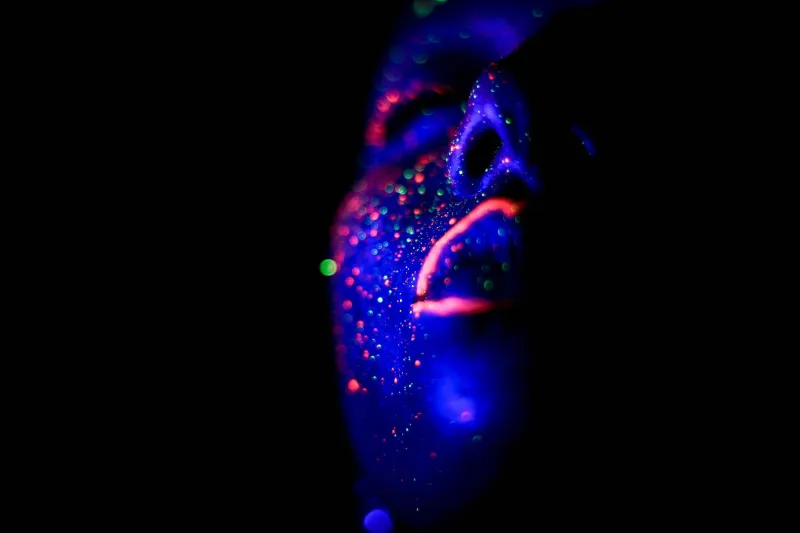
The glow aesthetic isn't just living on walls. It's on fingertips, on vintage denim, on sneakers, on tote bags, on literally any surface a creative person with $15 worth of fabric paint and a UV flashlight can get their hands on.
UV-reactive nail art has become one of the most talked-about techniques in the nail community right now. The concept is almost absurdly satisfying: a set that looks clean and minimal in natural light — maybe a sheer nude, maybe a soft swirl — that transforms into something completely wild under blacklight. Nail artists across the country are booking out weeks in advance for sets that essentially contain a hidden surprise. It's jewelry for people who love secrets.
On the thrift-flip side, creators are buying plain white or light-colored thrifted pieces — hoodies, jeans, canvas sneakers — and using UV-reactive dye or paint to add designs that are functionally invisible until you hit a blacklight. The result is clothing that functions perfectly normally in the real world and absolutely loses its mind at a party. It's practical. It's chaotic. It's genuinely genius.
Etsy shops specializing in glow-in-the-dark accessories have seen surges in traffic, particularly for items like resin jewelry with luminescent pigments, hand-painted patches, and UV-reactive stickers. Small makers are finding audiences specifically because they're working in this space where the product is, in the most literal sense, more than it appears.
The Psychology of Making Things Shine
So why now? Why is an entire generation collectively obsessed with things that glow?
Part of it is pure sensory craving. We live in a world that is, aesthetically, extremely beige. Open-concept everything. Greige walls. Minimalism that has somehow become its own kind of oppressive visual noise. The glow aesthetic is a direct rebellion against that — it's maximalist in the most spectacular way possible, and it costs almost nothing to access. A UV bulb is $10. A set of glow-in-the-dark paints runs about $20. The barrier to entry for making your space feel magical is genuinely low.
But there's something deeper happening too. There's a real psychological comfort in the idea of a hidden layer — something that exists beneath the surface of the visible world, waiting to be revealed. In a cultural moment defined by anxiety, overstimulation, and the relentless pressure to be legible and optimized at all times, the idea of beauty that only shows itself in the dark feels almost radical. It's not for everyone. It's not even for the daylight version of you. It's for the 2 AM version, the one who sits on the floor and stares at the ceiling and feels things too big to explain.
Glow art says: there is more here than you can see right now. And honestly? We needed to hear that.
How to Start Your Own Luminescent Era
If this is calling to you — and statistically, it is — here's where to begin:
- Grab a UV blacklight bulb and walk around your space. You'll immediately see what's already glowing (spoiler: your white walls are doing something weird and it's kind of amazing).
- Start small with glow-in-the-dark star stickers. Yes, the classic ones. No, you are not too old. They're $8 and they will make your ceiling feel like a planetarium and that is not a bad thing.
- Try UV-reactive acrylic paint for a small canvas piece before committing to a full wall mural. Brands like Neon Nights and Black Light UV Paints are popular starting points in the DIY community.
- Hit the thrift store with a UV flashlight. Some vintage fabrics react in wild and unexpected ways. You might find something that's already secretly glowing.
- Follow nail artists who specialize in UV work and save the techniques that speak to you, even if you're not doing your own nails. The artistry is worth studying.
The glow era is not about being seen. It's about choosing what reveals itself, and when, and to whom. It's about the radical, slightly unhinged, deeply human act of making the dark beautiful.
Flip the switch. See what's there.
✨