From Boring Class to Boss Era: How Doodle Artists Turned Margin Scribbles Into Actual Empires
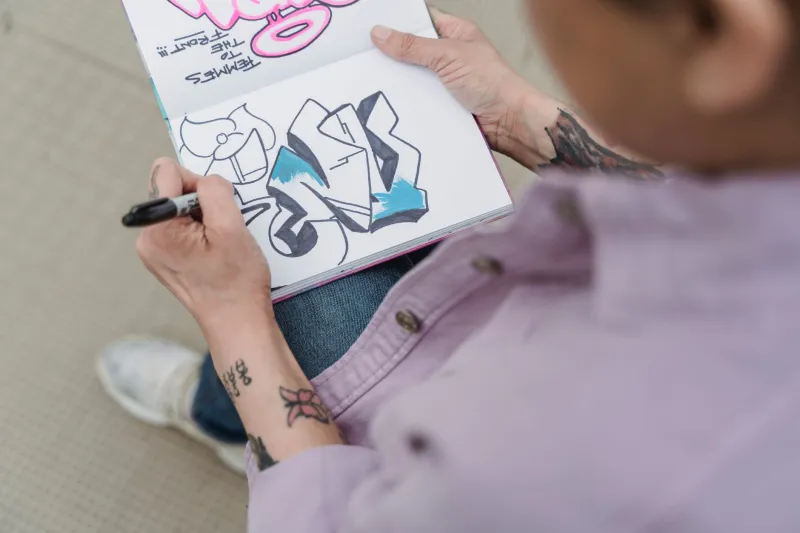
Let's paint a picture. It's 2014. You're in a lecture hall somewhere in the Midwest, a professor is explaining something deeply important about macroeconomics, and you are drawing a tiny frog wearing a cowboy hat in the corner of your notebook. You are not paying attention. You are, however, accidentally building the foundation of a future career.
Fast forward to now, and that frog? That frog is on a tote bag. That frog has 200,000 Instagram followers. That frog is the reason you quit your day job.
Welcome to the Doodle Economy — the completely unhinged, surprisingly lucrative, and honestly very inspiring world where the most casual, uncommitted, "I wasn't even trying" mark-making has become one of the most in-demand aesthetics on the entire internet.
What Even Is Doodle Art (And Why Does It Feel So Familiar)?
Here's the thing about doodle art: you already know what it looks like. It's the squiggly lines. The mismatched eyes. The little stars and spirals that show up for no reason. The characters with noodle arms and expressions that somehow perfectly capture the feeling of being tired on a Tuesday. It's the art style that says, I made this in 45 seconds and also I wasn't trying, and that's precisely the point.
Doodle art sits in this wild sweet spot between childlike and sophisticated, between effortless and intentional. It doesn't try to impress you with technical skill. It tries to make you feel something — usually a mix of "aww" and "same" and "wait, I need this on a sticker immediately."
And Americans, it turns out, are absolutely feral for it.
The Accidental Aesthetic That Took Over the Internet
Something shifted around 2019 and 2020 — a period when, coincidentally, a lot of people were stuck at home with nothing but time, anxiety, and whatever pens they could find. Doodle content exploded across TikTok and Instagram. Artists who had been quietly filling notebooks for years suddenly found audiences in the hundreds of thousands, not because they'd leveled up their technical game, but because they'd leaned harder into the wobbly, imperfect, unpolished style they'd always had.
Creators like these weren't posting finished gallery pieces. They were posting time-lapses of themselves drawing little guys on sticky notes. They were narrating their sketchbooks like personal diaries. They were making art that looked exactly like the stuff you doodled on your homework, except somehow it was also deeply, achingly relatable.
The comment sections filled up with variations of how are you inside my brain and this is literally me — which, in internet terms, is basically the sound of a money printer starting up.
Sticky Notes to Six Figures: The Monetization Pipeline
So how does a doodle actually become a career? Faster than you'd think, and through more channels than you'd expect.
Etsy was the first major launchpad for a lot of doodle artists. Sticker sheets, art prints, washi tape designs, enamel pins — the doodle aesthetic translates perfectly to small-format merchandise. It's bold enough to read at tiny sizes, charming enough to make people want it near them at all times, and reproducible enough to scale. A single viral sticker sheet can move thousands of units. A cute little character with a catchphrase can become a full product line before the artist has even updated their bio.
Then come the brand deals, which is where things get genuinely surreal. Companies have figured out that doodle art carries a specific emotional vibe — approachable, fun, a little chaotic, very Gen Z — and they want that vibe attached to their products. We're talking skincare brands, snack companies, app developers, even financial services trying to seem less terrifying by slapping a wobbly cartoon on their landing page. Doodle artists are getting paid to make brands feel human, and honestly, it's working.
Licensing is another revenue stream that quietly makes doodle artists very comfortable. Your little illustrated character ends up on a greeting card at Target, a phone case on Amazon, a notebook at the college bookstore. You get a cut every time. The original doodle — the one you made because you were bored — is now generating passive income while you sleep.
And then there's Patreon, digital downloads, online courses, and the whole ecosystem of creator monetization that means a doodle artist with a loyal audience can essentially build a full creative business without ever leaving their apartment. Which is, again, extremely on-brand for how this whole thing started.
The Radical Permission Slip Hidden Inside a Scribble
Here's what makes the Doodle Economy genuinely exciting beyond the money stuff: it's a direct challenge to everything we were taught about what "real" art looks like.
For a very long time, the art world operated on a set of gatekeeping assumptions — that skill was measured in technical precision, that value came from formal training, that the things you made casually and without intention didn't count. The doodle sits at the exact opposite end of that spectrum. It's the art you made when no one was watching, when you weren't performing creativity, when you were just letting your hand do whatever it wanted.
And the internet looked at that art and said: yes, actually, this is the one we want.
There's something deeply radical about that. It tells a generation of people who maybe couldn't afford art school, or who never felt "serious" enough to call themselves artists, that the thing they were already doing in the margins of their notebooks has value. Real, monetizable, audience-building value.
The Doodle Artist's Playbook (Unofficial Edition)
If you've been sitting on a notebook full of little guys and wondering if there's anything there, here's what the most successful doodle artists seem to have figured out:
- Consistency beats perfection. Post the wobbly thing. Post it anyway. The imperfection is literally the point.
- Find your character. The doodle artists who break through tend to have a recurring cast — a little creature, a specific face, a recurring visual motif that people start to recognize and attach to.
- Let it be personal. The doodle content that goes viral is almost always the stuff that feels like it came from a real emotional place. Relatable > impressive, every single time.
- Start with stickers. Low barrier to entry, high impulse-buy energy. If people are willing to put your art on their water bottle, they're willing to follow you forever.
The Margins Were Always the Main Event
Maybe the most beautiful thing about the Doodle Economy is what it says about creativity itself — that the art we make when we're not trying, when we're distracted, when we're just passing time, might actually be the most honest art we ever make. It's the stuff that comes out before the self-consciousness kicks in, before we start worrying about whether it's good enough.
The internet has a way of finding that honesty and amplifying it until it becomes a whole entire industry. And somewhere out there, a college student is currently ignoring a lecture and drawing a tiny frog in the corner of their notebook, completely unaware that they are, in fact, doing the work.
Keep scribbling, honestly. The margins were always the main event.