Terrible on Purpose: The Gloriously Messy Art Night That's Actually Fixing People
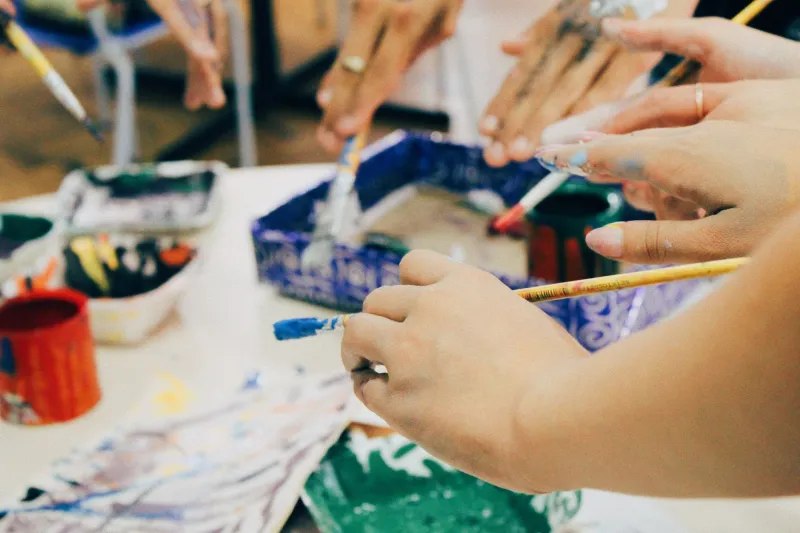
Picture the scene: eight adults sitting around a table covered in plastic sheeting, each holding a paintbrush with the energy of someone who has been told, explicitly and repeatedly, that they are not allowed to try. One person is painting a horse that looks like a melting couch. Another is making what they describe as "a sunset" but appears to be a screaming yellow rectangle. Someone in the corner is just making circles. Big ones. In brown.
Everyone is laughing. Everyone looks inexplicably, profoundly relieved.
Welcome to the intentionally bad art night — the counter-cultural gathering that's quietly becoming one of the most genuinely therapeutic things happening in American living rooms, rented studio spaces, and community centers right now.
The Problem With Being Good
Let's back up. Paint-and-sip culture — you know, those guided painting classes where you pay $45 to follow along and recreate a sunset or a wine glass or a vaguely autumnal tree — exploded in popularity for good reason. It gave adults permission to make something. It was social. It was low-stakes enough to feel approachable.
But here's what happened: it wasn't actually low-stakes. There was still a correct answer. There was still an instructor's version at the front of the room, and your version on the easel, and the quiet, persistent awareness that yours looked worse. The pressure to produce something good — or at least good-ish, good-adjacent, Instagram-uploadable — never fully went away.
For a generation that is already performing competence across every platform, every professional space, every social interaction, adding "also be good at art" to the list was, it turns out, not actually relaxing.
So people started flipping the script.
What "Bad on Purpose" Actually Looks Like
The rules of an intentionally bad art night are deceptively simple: there are no rules, except that you are not trying to make something good. You are, in fact, trying to make something terrible. The worse, the better. The more chaotic, the more clashing, the more anatomically incorrect — the more successful.
Hosts of these gatherings (which range from formal ticketed events in cities like Brooklyn, Austin, and Portland to totally casual hangouts in someone's apartment) describe them as having a particular energy that's hard to replicate anywhere else. The moment people internalize that there is no correct outcome, something visibly releases in their bodies.
"People come in tense," said one organizer in Chicago who runs monthly bad-art nights out of a rented community space. "They pick up the brush like it might bite them. And then you tell them the goal is to paint the ugliest dog they can imagine, and you watch them just... exhale."
The paintings that result are genuinely, magnificently terrible. Lopsided faces. Trees that appear to be on fire even when they're not supposed to be. Portraits of celebrities that look like the celebrity was described over the phone by someone who'd never seen them. Color combinations that should not exist in nature and absolutely do exist on canvas.
They're also, weirdly, kind of wonderful.
The Psychology Behind the Permission Slip
There's actual science backing up why this works, and it's not complicated: when you remove the possibility of failure, you remove the anxiety that prevents people from fully engaging with an experience.
Psychologists who study creative behavior have long noted that adults — unlike children — approach new creative tasks with significant self-consciousness. Kids will finger-paint with total abandon because they haven't yet learned to be embarrassed by imperfection. Adults have spent decades being graded, evaluated, and compared. The instinct to protect themselves from judgment runs deep.
Bad art nights essentially hack that instinct. If the goal is failure, you can't fail. And once you can't fail, you can actually play.
Play, it turns out, is something desperately under-resourced in adult American life. Between the hustle culture, the optimization obsession, and the constant low-grade stress of existing in 2024, genuine unstructured play — doing something with no outcome attached — is increasingly rare. These nights give it back.
From the Living Room to the Movement
What started as a niche, word-of-mouth thing has developed real cultural momentum. TikTok and Instagram are full of bad-art-night content, which has a delightfully paradoxical quality: people documenting their terrible paintings for an audience, which technically reintroduces performance anxiety, except that the performance is intentional terribleness, which somehow neutralizes it entirely.
The hashtags are chaotic and joyful. The paintings are monstrous. The people holding them up to the camera look happier than they do in most of their other content.
Some cities now have recurring events specifically marketed around this concept. Pop-up studios are offering "ugly art" nights alongside their traditional classes. A few entrepreneurial types have started selling bad-art-night kits — cheap canvases, low-quality brushes, garish paint colors — specifically designed to give you the worst possible tools and therefore the most freedom.
There are even competitive bad art nights, which is maybe the purest distillation of the concept: a room full of people aggressively trying to out-terrible each other, with prizes for the most chaotic result.
What You Actually Take Home
Here's the thing about the painting you make at a bad art night: it's yours in a way that a guided paint-and-sip recreation never quite is. You made every single decision. The wrong blue. The too-big eyes. The horizon line that refuses to be horizontal. All of it came from you, unfiltered, unjudged, just out.
A lot of people describe keeping them. Hanging them up. Feeling oddly attached to these objectively chaotic pieces in a way they don't feel about technically accomplished work.
Maybe because the bad painting is honest. It's you without the performance. It's what happens when you stop trying to be good and just start being present.
And in a world that is constantly asking everyone to be excellent, polished, and optimized, a painting of a horse that looks like a melting couch might be the most radical thing you make all year.