Ink, Feelings, and Absolutely Zero Chill: The Bullet Journal Obsession That's Quietly Rewiring America
Ink, Feelings, and Absolutely Zero Chill: The Bullet Journal Obsession That's Quietly Rewiring America
Somewhere between your third Micron pen purchase and your fourteenth YouTube tutorial on how to do a "minimalist yet chaotic" monthly spread, something shifted. The bullet journal stopped being a planner. It became a confessional. A therapist's couch made of paper. A place where your color-coded mood tracker quietly knows things about you that your actual friends do not.
And honestly? America is absolutely feral for it.
A Very Normal Tool That Got Very Weird Very Fast
For the uninitiated: bullet journaling — or BuJo, if you want to sound like you really live here — was originally developed by designer Ryder Carroll as a streamlined analog system for organizing tasks, notes, and goals. Simple bullets. Future logs. Monthly spreads. Clean, efficient, logical.
Then the internet got hold of it.
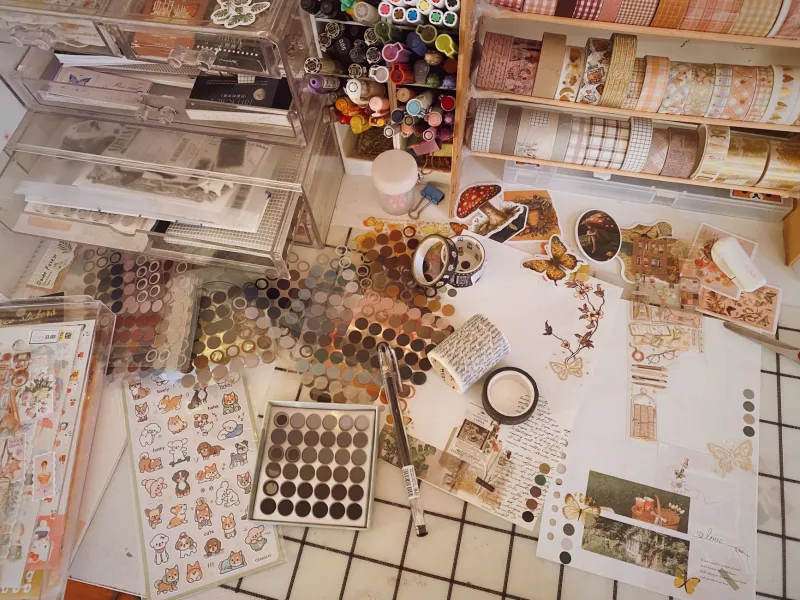
By the mid-2010s, Pinterest was overflowing with spreads so gorgeous they looked less like productivity tools and more like illuminated manuscripts from a medieval monastery that also sold washi tape. Then TikTok arrived and completely detonated whatever remained of the "simple system" energy. Now a single #bulletjournal search pulls up millions of videos — people painting watercolor title pages, hand-lettering weekly headers in three different fonts, building elaborate habit trackers shaped like sunflowers or constellations or little cartoon frogs.
It is, objectively, a lot. And yet the notebooks keep filling up.
The Spread That Knows Your Business
Here's the thing nobody really talks about in the aesthetic tutorials: the bullet journal isn't just pretty. It's revealing.
When you track your sleep every night for six weeks, patterns emerge that you didn't consciously notice. When you log your moods with tiny colored dots and then flip back through a month of them, you see the story your body was quietly telling while your brain was busy doom-scrolling. When your "grateful for" column stays blank for five days in a row, the blank space itself becomes information.
This is the part that makes bullet journaling feel less like a hobby and more like low-key therapy for people who haven't quite gotten around to booking an actual therapist. (No judgment. The waitlists are long. The notebooks are right there.)
Gen Z in particular has taken to this with an intensity that makes complete sense when you think about it. This is a generation that grew up being surveilled — by algorithms, by metrics, by follower counts — and somewhere along the way, they decided to start surveilling themselves, on their own terms, in a book that nobody else has to see. The bullet journal is data you own. Analytics that belong to you. A feed with an audience of one.
The Ugly Journal Revolution Is Actually Beautiful
If the Pinterest era of BuJo was all about perfection — the kind of spreads that made you feel vaguely inadequate about your own handwriting — then the current moment is its chaotic, liberated antithesis.
The "ugly journal" trend, which exploded across TikTok in recent years, is exactly what it sounds like: people deliberately making messy, unpolished, scribbled-over, emotionally unhinged notebooks and then posting them online. Crossed-out words left visible. Pages that are half doodle, half rant, half accidental ink smear. Stickers slapped on crooked. Margins filled with anxious little drawings of eyes and spirals and the word "ANYWAY" written aggressively in all caps.
These videos rack up millions of views. Because people recognize them. Because the ugly journal looks like the inside of a brain, and brains are not dot-grid perfect, and it is genuinely radical to say so out loud — or, well, to say so in ink and then point a camera at it.
There's something deeply Bambitsol about this energy: the weird and the wonderful colliding on a page, the refusal to perform neatness when the truth is messier and more interesting.
Pens, Washi Tape, and the Economy of Obsession
Let's be real for a second: the bullet journal community has also spawned one of the most enthusiastically specific consumer ecosystems in recent memory. The Muji pens. The Tombow brush markers. The Leuchtturm1917 notebooks that cost $25 and feel like holding a small, elegant promise. The washi tape collections that have quietly colonized entire desk drawers across the continental US.
Craft stores love BuJo people. Stationery brands love BuJo people. YouTube sponsors definitely love BuJo people.
But here's the twist: even the most maximalist, fully-stocked, forty-seven-different-pen-colors bullet journalist will tell you that the actual magic happens when you just start writing. The tools are fun. The practice is the point. You can do this with a $1 notebook from the dollar section at Target and a single ballpoint pen, and it will work exactly as well as the $200 setup, because the notebook is not the product. You are the product — or rather, the process of understanding yourself is the product, and that has always been free.
Why This Particular Piece of Paper Hits Different
We live in an era of frictionless digital everything. Notes apps, calendar syncs, reminders that pop up on your wrist. Information moves instantly and disappears just as fast. Your thoughts exist somewhere in a cloud, technically accessible, practically untethered.
The bullet journal is the opposite of all of that. It is slow. It is physical. It requires you to sit with your own handwriting, which is to say, it requires you to sit with yourself. You can't batch-delete a bad month. You can't edit your mood tracker retroactively. The record exists, in ink, in your hand, and that permanence is exactly the point.
For a generation that has been told their attention spans are broken, their mental health is in crisis, and their futures are uncertain, the act of filling a page — slowly, deliberately, in your own weird handwriting with your own weird doodles — is quietly defiant. It says: I was here. I felt this. I made something out of it.
That's not just journaling. That's an archive. A monument to the unremarkable, gorgeous chaos of being alive right now.
So, Should You Start One?
If you've read this far and you're not already reaching for a notebook, we honestly don't know what else to tell you. Start ugly. Start messy. Draw a little frog in the corner if you want to. Track your water intake or your nap frequency or how many times you said "I'm fine" when you absolutely were not.
You don't need the perfect pen. You don't need to watch seventeen setup videos first (okay, watch two, maximum). You just need a page and the willingness to be honest on it.
The notebook will keep your secrets. And it will also, gently, absolutely, show them back to you.