Knotted, Sold, and Absolutely Thriving: How the Humble Friendship Bracelet Became a Cottage Industry
Let's be honest — nobody saw this coming. Not the craft store buyers who restocked their embroidery floss sections three times in a single summer. Not the Etsy algorithm, suddenly flooded with listings featuring words like "Taylor," "Eras," and "custom beaded name." And definitely not the seventeen-year-old in suburban Ohio who, somewhere between the Pittsburgh and Chicago tour stops, accidentally became a small business owner.
The friendship bracelet has always been a thing. But in 2023 and into 2024, it became the thing — and then, quietly, steadily, it became a whole entire career path.
From Wristband to Wrist Economy
Here's the origin story everyone already knows but that somehow keeps getting more interesting the more you dig into it: Taylor Swift's Eras Tour turned bracelet trading into a full-blown cultural ritual. Fans showed up with dozens — sometimes hundreds — of handmade bracelets to swap with strangers in the crowd. It was chaotic, it was joyful, and it was, in retrospect, a masterclass in the economics of gifting culture.
But here's what happened next that people aren't talking about enough: a significant chunk of those bracelet-makers didn't stop when the tour left town. They kept going. They got better. They got faster. And then they opened shops.
According to Etsy's own trend reporting, searches for handmade friendship bracelets spiked dramatically in 2023 and haven't really come back down. The platform saw a surge of new sellers in the jewelry and accessories category, many of them young women between the ages of 16 and 25, many of them with zero prior business experience and absolutely zero chill about their new obsession.
The Craft Is the Product — But the Story Is What Sells
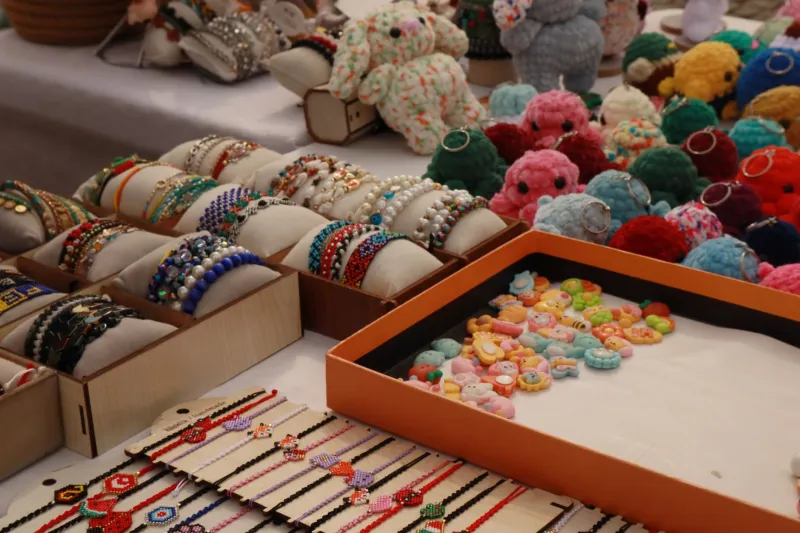
Walk through any major craft fair, pop-up market, or summer festival in America right now and you'll find them: folding tables draped with velvet display boards, covered edge-to-edge in tiny knotted masterpieces. Some are selling for $3. Some are selling for $35. And the difference between those price points isn't always the materials — it's the narrative.
The makers who are genuinely building businesses out of this aren't just selling bracelets. They're selling hyper-personalized wearable stories. Custom name bracelets with inside jokes worked into the pattern. Color combinations chosen to match someone's astrology chart. Bracelets that spell out song lyrics in tiny letter beads. Memorial pieces. Milestone markers. "I survived my first year of college" bracelets. "My dog just died and I needed to make something" bracelets.
This is where the friendship bracelet quietly leveled up into something that fine jewelry designers have been charging thousands of dollars for: emotional specificity. The ability to wear a feeling on your wrist.
"People don't come to my booth wanting a bracelet," says one 21-year-old seller who runs a pop-up at markets across the Pacific Northwest. "They come wanting to feel seen. The bracelet is just the vehicle."
TikTok Did What TikTok Does
No trend story in 2024 is complete without acknowledging the TikTok pipeline, and this one is no exception. The platform didn't just amplify bracelet culture — it created an entirely new ecosystem of bracelet content that functions like its own little creative universe.
There are the "pack an order with me" videos, where makers narrate their shipping process with the energy of someone hosting a very cozy talk show. There are the time-lapse knotting tutorials that rack up millions of views because watching someone's hands move that fast is genuinely hypnotic. There are the "how much I made at my first craft fair" confession-style vlogs that somehow manage to be both financial transparency and emotional vulnerability at the same time.
And then there are the niche corners: the beaded bracelet collectors who trade rare letter combinations like they're Pokémon cards, the "bracelet as journaling" creators who document their emotional state through color theory and pattern choice, and the absolute chaos of "blind swap" videos where strangers mail each other custom bracelets based on nothing but a vibe.
All of it feeds back into the economy. Every tutorial is also a product demo. Every "get ready with me" is also a brand introduction. The content and the commerce are so intertwined at this point that separating them feels almost beside the point.
The Business Side Is Weirder (and More Legit) Than You'd Think
Here's something nobody's grandmother predicted when she taught her how to do a basic square knot: friendship bracelet makers are out here filing Schedule C forms, negotiating wholesale pricing with bead suppliers, and building email lists.
The micro-entrepreneurship angle is real and it's genuinely fascinating. Many of these makers started with a $20 bead kit from Michael's and are now placing bulk orders from overseas suppliers, managing inventory spreadsheets, and thinking seriously about whether to incorporate as an LLC.
The festival booth hustle alone deserves its own documentary. Makers who do the pop-up circuit talk about it with the intensity of seasoned vendors — knowing which markets have the right foot traffic, which price points move fastest before noon versus after 3 PM, which display layouts stop people in their tracks. This is not hobby talk. This is small business strategy, delivered with glitter on your fingers.
Some have taken it even further. Custom bracelet commissions for wedding parties. Brand collaborations where companies pay for logo-adjacent color palettes worked into wearable merch. Wholesale accounts with boutiques. One particularly entrepreneurial 19-year-old from Texas reportedly cleared over $10,000 in a single summer festival season — enough to cover her first semester of college.
Why This Moment Matters Beyond the Bracelets
It would be easy to write this off as a cute trend — a pandemic-era craft hobby that got a celebrity boost and will eventually fade back into the summer camp drawer where it came from. But that reading misses something important about what's actually happening here.
Young Americans are increasingly skeptical of traditional career paths. They watched their parents grind through jobs that disappeared anyway. They graduated into a job market that asked for five years of experience for entry-level roles. And somewhere in that disillusionment, a lot of them looked at their hands and thought: what if I just made something?
The friendship bracelet boom is, at its core, part of a much larger story about creative labor, economic creativity, and the very human need to make things that mean something. The fact that it's also adorable and comes in every color of the rainbow is just a bonus.
The craft didn't grow up and get serious. The people making it did. And they brought their embroidery floss with them.
Whether you're 300 bracelets deep on your Etsy queue or you just learned the square knot last Tuesday, Bambitsol sees you — and we think your little thread empire is absolutely unhinged in the best possible way. ✨