Stick, Poke, Regret (Maybe): The Wildly Honest Truth About DIY Tattoos and the Skin They Live On
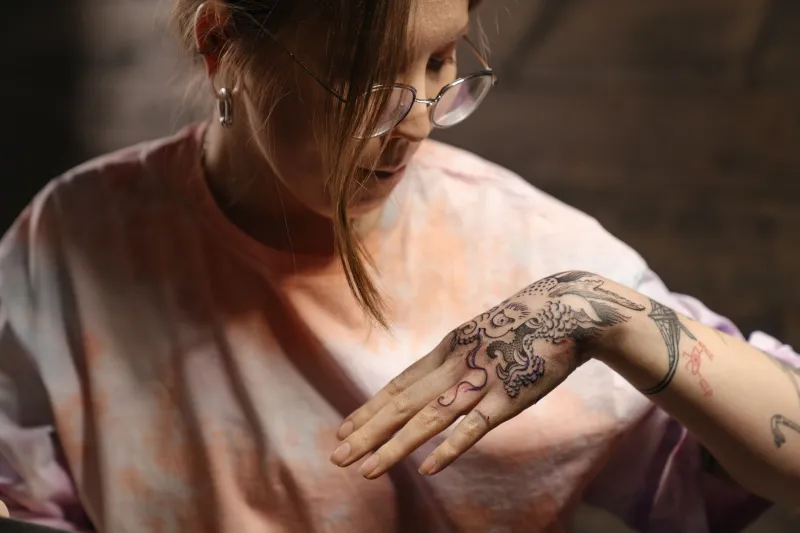
Somewhere in America right now, someone is sitting on a dorm room floor with a sewing needle, some India ink, and an extremely confident YouTube tutorial queued up. They have a design in mind — something small, something meaningful, something that will look incredible on their ankle forever. They are about to make a permanent decision with a craft supply.
This is the stick-and-poke moment, and it is happening everywhere.
The DIY tattoo movement has exploded over the past several years, riding the same wave of handmade-everything energy that brought us sourdough starters and macramé wall hangings. But unlike a lumpy loaf of bread, a tattoo does not compost. It lives on your body, potentially forever, fading and blurring and telling the story of the night you decided this was a good idea.
We wanted the full picture. So we asked the people who give tattoos professionally, the people who've healed their own DIY work, and the dermatologists who've seen what happens when things go sideways.
Why People Do It (And Why It Makes Total Sense)
Before we get into the risks — and there are real ones — let's honor the impulse, because it's genuinely worth understanding.
The appeal of stick-and-poke isn't just about the cost, though the fact that a professional tattoo can run several hundred dollars for something small is obviously a factor. It's about agency. It's about the intimacy of marking your own body with your own hands, or having a friend do it, in a space that feels personal rather than clinical.
"There's something really powerful about the slowness of it," says Maya, 24, a graphic design student in Portland who has given herself three stick-and-pokes over the past two years. "A machine tattoo is done in like twenty minutes. With hand-poking, you're sitting with it for hours. You're really choosing every single mark."
That meditative quality — the deliberateness of it — is something professional hand-poke artists talk about too. "It's a different relationship with the process," says Jordan, a professional tattoo artist in Austin who specializes in hand-poke work. "When it's done right, it's actually a legitimate technique with a long history. Indigenous tattooing traditions from across the world used hand-poke methods. It's not new. It's just been reclaimed."
The issue isn't the technique itself. The issue is what happens when it's done without the training, tools, and sterile environment that make the technique safe.
The Part Where We Get Honest About the Risks
Dr. Simone Reyes, a board-certified dermatologist practicing in Chicago, has seen the full spectrum of DIY tattoo outcomes in her office. "I want to be clear that I understand why people do this," she says. "But I also want people to understand what the actual risks are, because they're not trivial."
The most immediate concern is infection. The skin is a barrier organ — its entire job is to keep things out. When you puncture it repeatedly with a needle, you're creating hundreds of tiny entry points for bacteria. A sterile needle used once, in a clean environment, with properly prepared skin, is manageable. A sewing needle from a craft drawer, used on a dorm room floor, is a different situation entirely.
Infections from DIY tattoos can range from minor localized reactions to serious skin infections requiring medical treatment. "I've seen cellulitis, I've seen abscesses," Dr. Reyes says. "And I've seen people who waited too long to come in because they were embarrassed or thought it would resolve on its own."
Beyond infection, there's the question of ink. Professional tattoo inks are formulated specifically for use under the skin. India ink — the most common DIY substitute — is not. "India ink can contain compounds that cause granulomas, which are inflammatory nodules under the skin," Dr. Reyes explains. "They can appear months after the tattoo and can be painful and difficult to treat."
And then there's the aesthetic reality of what DIY work looks like as it ages.
The Long Game: What Actually Happens When It Heals
Kayla, 26, got a stick-and-poke star on her wrist at nineteen. "It looked so cool when I first did it," she says. "Like, genuinely I was obsessed. It was small and delicate and exactly what I wanted." Today, seven years later, it's a gray smudge about twice the original size. "It spread. The ink just... migrated. It doesn't look like a star anymore. It looks like a bruise that never went away."
This is an extremely common outcome, and it's one that Jordan, the professional artist, sees a lot when clients come in for cover-up work. "The issue with untrained hand-poking is depth inconsistency. If you go too shallow, the ink falls out during healing. If you go too deep, it spreads. Getting the right depth consistently across an entire design takes real practice — it's not intuitive."
The results are wildly variable. Some people's DIY tattoos heal beautifully and hold up for years. Others fade to almost nothing within months. Many end up somewhere in between: legible but blurry, charming but uneven, a permanent record of a moment that has since gotten a little fuzzy around the edges.
The Middle Ground Nobody Talks About
Here's where it gets nuanced, because the story isn't simply "don't do it."
For many people, the imperfection is the point. The blurry lines and uneven shading are evidence of a specific moment, a specific hand, a specific decision made with intention. There's a whole aesthetic movement built around DIY tattoo work that celebrates exactly this quality — the handmade wobble, the ghost of a line that didn't quite land, the proof that a human being made this.
"I have five stick-and-pokes and I love all of them, including the ugly one," says Marcus, 23, from Nashville. "My friend gave me that one and it looks terrible and I will literally never remove it because it's the most us thing I own."
If you're going to do this — and many of you absolutely will, because you are creative, autonomous humans who make your own choices — the harm reduction information matters. Use proper tattoo needles, not sewing needles. Use ink formulated for tattoos. Sterilize everything. Work on clean, properly prepped skin. Do not tattoo over bony areas, joints, or areas with thin skin. And take the aftercare seriously — it's not optional.
Professional hand-poke artists also exist in basically every major city, and they can give you the intimacy and handmade quality of the technique without the infection risk and depth inconsistency. It costs more than a sewing needle. It costs significantly less than treating a skin infection or covering up a blurry mistake.
The Ink You Earn
At its best, the DIY tattoo movement is about the same thing all the best creative impulses are about: ownership. Making something with your hands that didn't exist before. Wearing your decisions on your body like a badge of creative courage.
At its worst, it's a craft project with permanent consequences and potential medical complications.
Most people land somewhere in the middle — with a small, slightly blurry mark on their body that tells a story nobody else has, made in a moment of creative confidence that they probably don't entirely regret.
That's the thing about permanent decisions. They become part of the texture of who you are. Even the imperfect ones. Especially the imperfect ones.